

Tending the Marks we Make
How wind, medicine, and art teach us to gather what matters and place one true line

The world keeps adding; autumn invites a little space. How does your mark-making support connection and creative clarity?

Wind, Winnowing, and Tending
On Littlejohn Island, the wind has work to do this week. It combs the maples and oaks, gathers what’s finished, and carries it toward the ocean. You can hear the branches realign after each gust. Paths appear beneath the trees where there weren’t any the day before.
We call it harvest. It is tending, too. The tide lifts and lowers the island’s edges, threading the seaweed with leaves, and the air smells of woodsmoke.
Last weekend, I ran the Westside Trail with a pocketful of acorns and questions about legacy. The winnowing wind answered with a lesson in discipline, and what it means to leave one’s mark intentionally.
I first learned the language of creative mark-making from encaustic artist Dietlind Vander Schaaf on Radio Maine.
Mark-making is the visible trace of a choice. It can be a brushstroke on a panel, the tone we set in a room, a policy we draft, the cadence of a meeting, the line of a scar, or even the pattern of attention we repeat. Single marks gather into a line; lines gather into a body of work; bodies of work gather into a legacy.
The repeated marks… are for me a kind of language. —Dietlind Vander Schaaf

Marks in medicine and leadership
When we picture legacy, we often imagine a ledger: what our children will inherit, what the team will remember, the projects that might outlast us.
Medicine taught me to consider legacy in smaller, embodied terms. I have left physical marks on people through procedures in the family-medicine setting. After trying to leave the kindest lines possible, I’ve subsequently admired how the body met me with its own healing work.
Knowing that the vestiges of my marks remain on people’s bodies is humbling. Knowing my marks may remain on people’s lives as a physician, a leader, or any number of other roles I’ve had is more humbling still.
Mark-making is a practice, not a product. Early on, we believe precision is the point; later we learn that application is. We move from performance to stewardship, from reacting to choosing. Small marks—tone in a meeting, space protected for thinking, credit shared freely—placed intentionally and consistently, become a line others can follow.
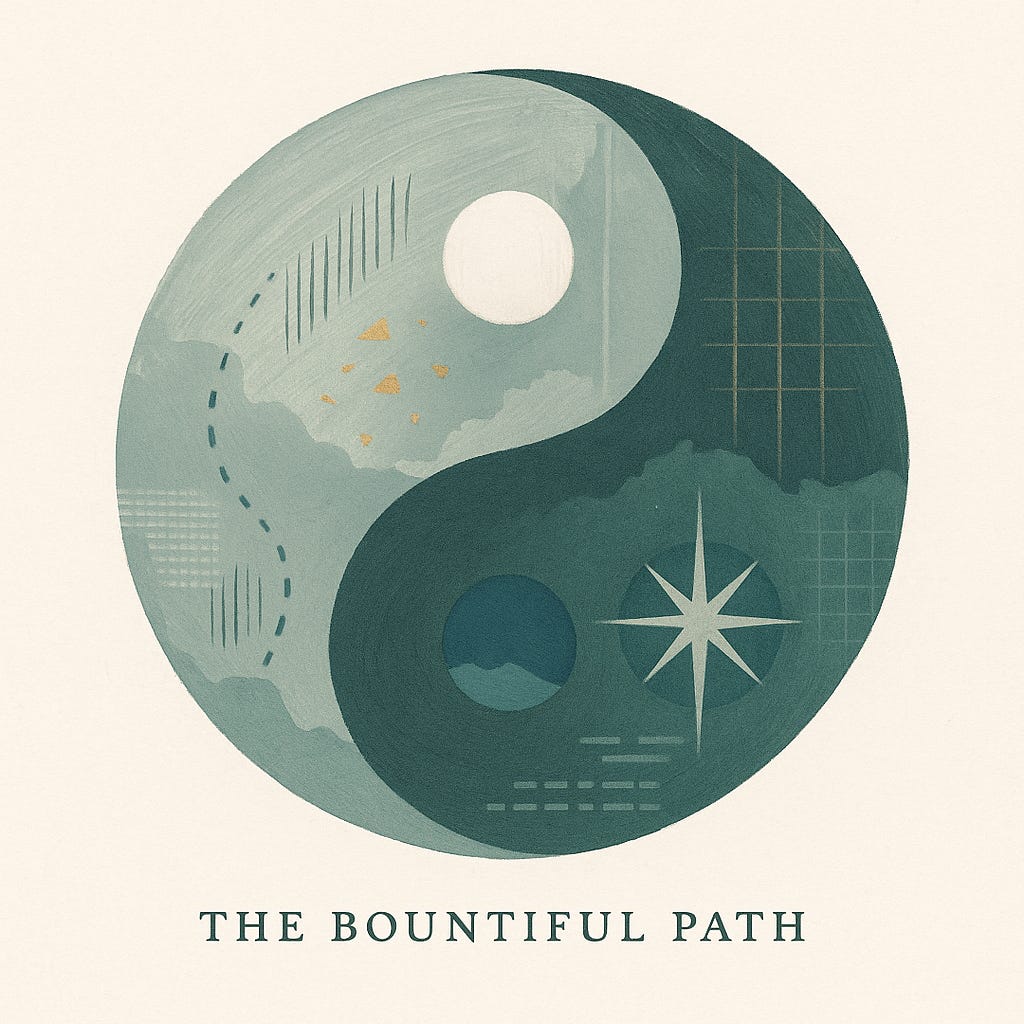
Creativity and the yin/yang of making
At our recent Radio Maine Live gathering, we named legacy through creativity. We were joined by Jim Brady (Olympic silver medalist and Portland community builder whose thoughtful design and redevelopment reshapes how people experience this city), Grace DeGennaro (artist exploring balance, time, and spiritual continuity through geometry, myth, and pattern), Dr. Jacey Goddard (osteopathic physician integrating mind, body, and spirit to help patients realign with themselves), and Michael Keighley (veteran and trauma-informed yoga teacher helping others rediscover strength and choice). Each offered a living example of mark-making—and the legacies that gather when practice meets purpose.
In this week’s Radio Maine conversation, artist Emily Sabino and I compared notes on leaving corporate architectures for a studio and a path of one’s own. When I spoke with her in anticipation of the interview, she alluded to a view of creating new paths using a traditional frame familiar from Taoism and Chinese philosophy: yin and yang.
Yin receives, yang acts. In transitions, we may try to skip the listening and processing required by yin because action feels safer. But if we spend all our time acting without intention, our marks turn to noise; if we only ponder without producing, our marks never land. Legacy is the braid: receptivity that listens for the next true line, and bravery that makes it visible.
There is risk in making a mark. Artists know the tremor before a first stroke. Physicians know the gravity of a scalpel’s path. Leaders know the weight of a decision that cannot be unmade. It can feel safer to stay in the thinking, to rehearse a perfect future lineage of impact. Yet autumn’s lesson is to choose.
Intentionality: from noise to signal
“I just started working small… I would get these little intuitions, paint this and just let my hand go and not think too much.”—Emily Sabino
How do we act inside the courage of choosing without grand gestures? We shorten the distance between intention and action. Habit and attention science both suggest that small, trigger-based practices are sticky. Pair a desired behavior with an existing cue, and do the smallest version that “counts.” Because we anchor the behavior to something we already do, we reduce decision fatigue so that creative energy goes toward the mark itself.
In leadership, this looks like a two-sentence agenda sent before the meeting. In medicine, it’s a breath at the threshold before entering the room. In the studio, it’s one line on a surface as the kettle warms. None of these will trend on a dashboard. All of them accumulate into a generous line.
Doorway Ritual
What it is: A micro-practice anchored to a literal or figurative threshold—the “doorway”—that turns intention into action in the pause you already have.
Word: GATHER
Ritual: At your next doorway—front door, clinic doorway, studio entrance—pause long enough to feel the handle in your hand. Gather three breaths, then place one small mark that moves your work: jot a title, lay a first brushstroke, record a 15-second voice note with your opening sentence.
Share (self-check): “What single mark did I make today, and what did it gather?”
Creative partner variant: Swap a 10–20 second voice memo with a collaborator naming your mark and its purpose. No critique, just witness.

Why this may matter for you
If “legacy” feels distant or heavy, shrink it to scale. Because you gather before you act, you reduce noise and increase signal, so that your mark is truer and your effort compounds. Because you place one visible line each day, others can find you—and sometimes, join you. The Bountiful Path exists for this: season-guided prompts, leadership-tested practices, and art-informed courage that help you reconnect with your work and with one another when life pulls hard.
Pause + Reflect
What is the smallest honest mark you could make in the next hour that future-you would be grateful to inherit? Consider sharing your response in the comments.
Closing the Circle
Here on the island, autumn clarifies. The wind gathers what is done and reveals what remains. Art reminds us that a single stroke can reorient a whole piece. Medicine teaches us to act with care and let the body do its work. Leadership asks us to choose the next right thing, then to make it visible.
We do not control how the world will carry our marks forward. We do control the intentionality to gather, to place one line, and to keep showing up—together. That is a legacy we can live inside today.
As we make our marks, we’ll return next week to bearing witness and joining in person through Artful Escapes, two small waypoints to help us see—and be seen—with care.
✨ Thank you for reading, and for walking this bountiful path with me.
Warmly,
Lisa
Join artists and other creative-minded souls at the upcoming Portland Art Gallery November Exhibition, Opening November 6th, 5-7 pm.
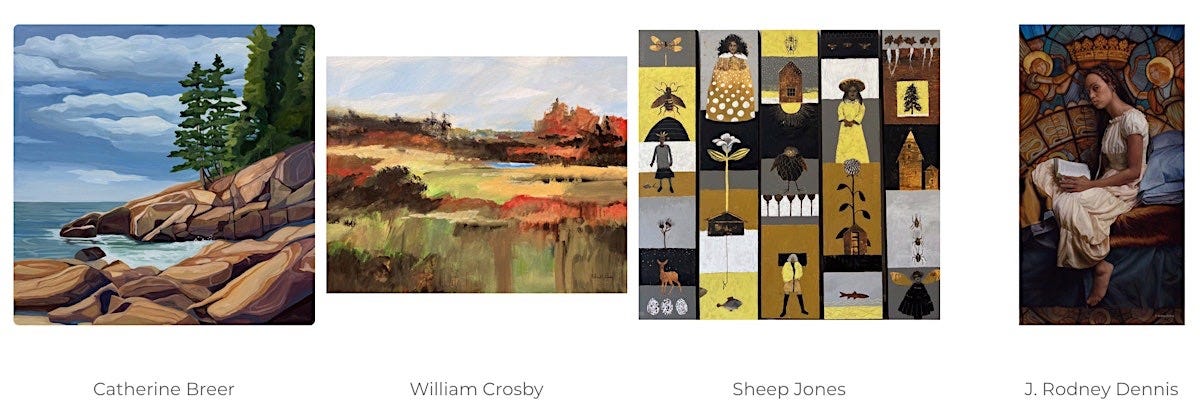
The Bountiful Path: Offering seasonal practices for real connection, rooted in medicine, leadership, and art.
What a beautiful writing and I love that Dietlind’s work was included. She comes to mind whenever I am making marks with art.
That is a great idea to share voice memos (and/or an equivalent small creative act), as a way to ease into something new. Trick the brain to calm down and trust the intuitive flow. Great article!