

First Light, First Steps: On Beginning Well in a Changing Season
Storms melt and refreeze, holidays approach, and the year turns. The beginnings we choose now can shape more than we know.

These days can feel like a swirl: bright skies, tired bodies, and one more list before year’s end. It is tempting to rush through. This week is an invitation to look more closely at our beginnings, and to consider what we might be setting in motion for ourselves and for others.

Wind, rain, ice, and quiet decorations
Last week, wind and rain swept through our part of Maine and stripped the island trails of their early snow. For a day or two, it almost felt like November again, with soft, muddy ground wherever the sun had reached, while pockets of ice still clung to the shaded places under the trees.
Then the temperature dropped.
On a recent run across the Littlejohn Island causeway, the water that had mirrored the sky only days earlier had hardened into ice, pleated into textured sheets by the changing tides. The air felt sharper. Snow is in the forecast again before Christmas.
The skies, however, have been startlingly clear, as if the solstice light decided to linger. Blue mornings. Gold afternoons. The sun riding low but bright over the bay.
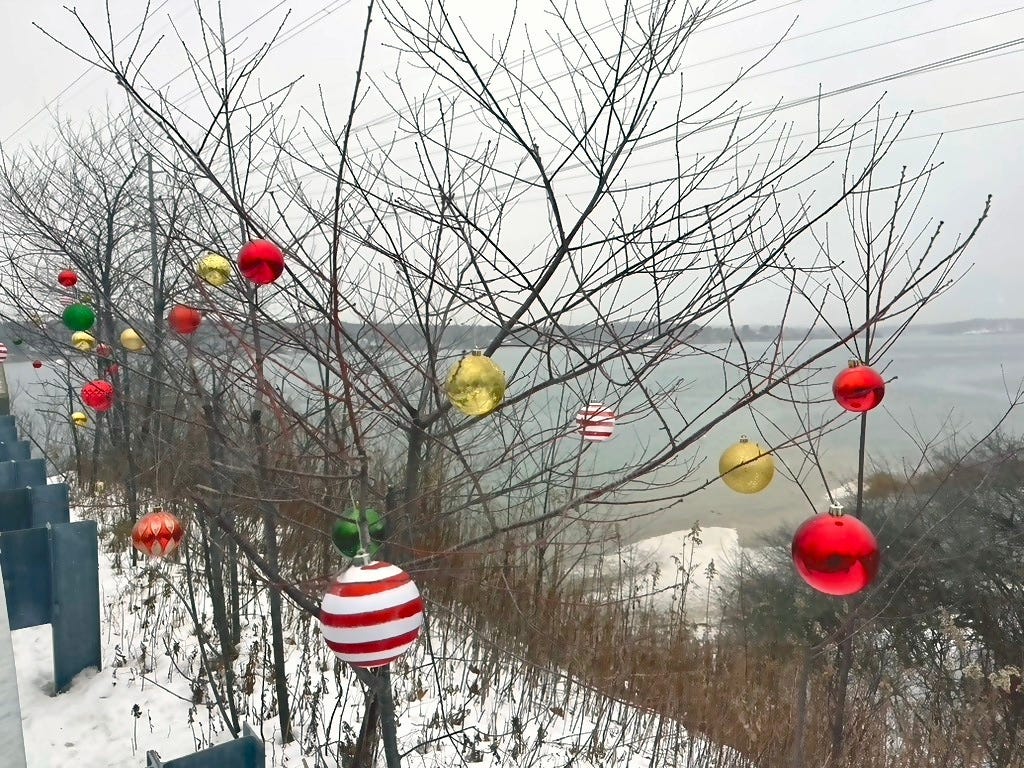
Near the Cousins Islands bridge, an anonymous neighbor hung holiday ornaments on a cluster of roadside branches earlier in the month. Yesterday, a small lit tree appeared at the bridge’s center, as it does every year, a quiet generosity from someone who once decided this ordinary stretch of road should shine a little brighter for all of us.
There is a kind of collective effervescence in the air, knowing that many households nearby are preparing to celebrate. Some are planning traditional Christmas services and dinners. Others are lighting candles for different winter holidays, the ones we reflected on recently in our Lights of Winter post.
Behind each of these practices is an origin story.
For my own family, the story of a birth in a distant time and place has shaped not only religious observances, but the music we sing, the recipes we cook, and the way we think about gathering at this time of year. We are hardly alone in this. The Christmas origin story, in its many interpretations, has influenced cultures, calendars, and communities across centuries.
And origin stories are rarely simple.
In many families, especially blended families or newly married couples, December is a puzzle of inherited traditions. One household grew up with midnight services; another with morning hikes. One side opens gifts on Christmas Eve; the other on Christmas morning. Each year becomes its own small act of co-creation: what do we keep, what do we adapt, what new pattern do we begin together?
Zoom out further, and the complexity deepens. Different religions carry different origin stories for this season—some overlapping, some diverging, some in tension. The birth of Christ, for example, is seen in profoundly different ways by Judaism, Christianity, and Islam. The same event sits inside very different narratives, with very different implications.
Deciding how to be culturally respectful and responsive in this larger context is every bit as important as being thoughtful with the traditions inside a single family. As I wrote about in my reflection on The Spirit Catches You and You Fall Down, the cost of assuming a shared story—rather than asking, listening, and learning—can be high in health care and beyond.
“Every tradition we see in December began once as a choice. Someone, somewhere, started.”
The work, it seems to me, is not to erase origins, but to hold them with enough humility that we can honor our own stories while making room for others. Similar to an artist facing a blank canvas, we are invited to be mindful of the first mark we make, without becoming so afraid of “getting it wrong” that we never begin at all.

Adam Moss and the power of first moves
In the early mornings this month, one of the books on my table has been The Work of Art by Adam Moss. Among many insights, one theme keeps echoing: the importance of paying close attention to the beginning of a creative act.
Those first moves may seem tentative. A single brushstroke. A few notes hummed into a phone. A blank document titled “Draft.” An opening question in an exam room.
Yet again and again, the artists Moss interviews point to those early decisions as disproportionately powerful. The way they enter the work shapes what becomes possible. The initial constraints, the first colors chosen, the tone of the first paragraph, the first conversation with a collaborator: these early choices are the soil the rest of the project grows in.
We know this instinctively in medicine and leadership.
The way we open a visit often defines how safe a patient feels telling the full story.
The tone of a first team meeting can set norms for candor, curiosity, and blame.
The language in an organization’s founding documents quietly shapes who feels welcome and who does not.
The spirit in which we first talk about a holiday, or a diagnosis, or a ritual can signal whether difference is allowed, or only quiet agreement.
What begins as one person’s decision can, over time, become inherited culture.
The Christmas story is a large-scale example of this. A birth narrative, rooted in a specific time and place, has been told and retold until it has become a template for hope, sacrifice, and belonging in communities far beyond its original context. Every generation adds its own layer of interpretation and practice.
The same is true, in humbler ways, in our own families.
Perhaps a grandparent once decided to invite a neighbor who had nowhere else to go for dinner. Decades later, a sprawling “friends and family” table is now simply “how we do Christmas.” A small intentional beginning has become a tradition that shapes how younger generations think about hospitality.
What we do at the origin of anything is rarely just about us. It can ripple outward into our children, our teams, and our communities. And, as in art, we are asked to be attentive and ethical in our first moves, while remembering that revision and repair are always part of the process.

Layers of light and sea: Whitney Heavey
Later this week our Off the Wall feature will focus on painter Whitney Heavey, whose large, layered coastal paintings feel especially resonant right now.
Whitney grew up near the ocean and now lives on Cape Cod. Her paintings are built from many returns to the same places, many passes over the same canvas. She begins with photos, sketches, and even video, then works primarily in oil, adding and refining over days, weeks, or months until each piece feels complete.
“There’s so much beauty in the natural world, but you have to be present to see it.”
Whitney Heavey
Water is part of her family origin story. A grandfather who captained an ocean liner. A father who navigated a submarine. A grandmother who walked the shore with her, teaching her to notice color, tide, and small treasures left in the sand.
Those early experiences did not dictate her work, but they did shape her way of seeing. Each painting now is both a new beginning and another layer on top of that inherited compass.
Her process also reminds us that first marks matter, but they are rarely final. One of her toughest paintings went through thirty iterations before she found its true form. If she had stopped after the first or second attempt, the work we now see would not exist.
Our own beginnings can work like this too. We choose as wisely as we can, then stay open to learning. The origin is important, and so is our willingness to revise and add layers with care.

Sean Thomas and the stories that start a career
On Radio Maine this week, we speak with Sean Thomas, manager of the Portland Art Gallery and an artist in his own right. Sean has spent years behind the camera, in studio visits, and now in the gallery, helping connect artists and collectors.
What struck me in our conversation was his emphasis on both consistency and origin. When he reviews portfolios from emerging artists, he looks for evidence that they are showing up to their work again and again, rather than waiting for a single breakthrough moment. He is also deeply curious about the story that underlies the work: where it began, how it has evolved, and what the artist is trying to explore next.
“Every time you’re talking about yourself and what you do and what your drive is, you are putting yourself out there.”
Sean Thomas, Radio Maine
In the gallery, that origin story does not stay in the artist’s studio. It becomes part of what a collector brings home. When we choose a painting for our living room, we are not just choosing colors. We are inviting in a piece of someone else’s beginning, and weaving it into our own.
Glimmers, gratitude, and small beginnings
In this week’s solo episode of The Bountiful Path: A Radio Maine Series, Glimmers and Gratitude, I share a simple idea that has been sustaining me lately: the practice of noticing “glimmers.”
These are the small, often overlooked moments that bring us back to center. A single leaf catching the light. The sound of laughter in the next room. The warmth of a mug between your hands.
“These glimmers are not trivial. They are trail markers. They guide us home.”
In medicine, we talk a lot about big foundations: food, movement, sleep, connection. Glimmers are like micro-beginnings inside those foundations. Each one is a small origin story of gratitude, a chance to shift from automatic stress to intentional presence.
Over time, the way we begin our days, our visits, our meetings, and even our commutes with these tiny moments of attention can reshape our inner landscape.
Why this may matter for you
You may be moving through these days wearing many hats: clinician, leader, caregiver, organizer, friend. It can feel as though your job is to keep everything going, no matter what the weather, the headlines, or the inbox brings.
Origin stories remind us that we do not have to remake the world overnight. We are invited to start in smaller, more human places: how we open a conversation, how we mark an arrival, how we honor the stories that gave rise to our traditions while making space for those that differ from our own.
In clinical care, this can mean asking about a patient’s beliefs and family practices before we assume their preferences, especially when cultural or religious origins differ from our own. In families, it can mean talking openly about what each person values in a holiday, instead of silently trying to replicate what “should” happen.
Like the first mark on a canvas, our beginnings benefit from mindfulness. But if we wait until we are certain we will offend no one and disappoint no one, we will never start. The invitation is to be thoughtful and curious, willing to listen and adjust, without becoming paralyzed.
When we tend to beginnings with a bit more intention, we often find that the middle and end feel more aligned too. The first note shapes the song. The first brushstroke shapes the painting. The first question shapes the relationship.
Pause + Reflect
As you move toward whatever holiday you may be celebrating and the turn of the year, consider:
What is one beginning you would like to shape more intentionally, so that its impact ripples in a direction you can feel good about—for you, and for the people and stories it touches?
Closing: carrying our origin stories forward
Out on the causeway, the ice will thicken and thin again before spring. The ornaments on the roadside trees will eventually come down, only to reappear next December. The stories we tell this week, around tables and in exam rooms and over text threads, will become part of how someone remembers this season.
We cannot control how every story unfolds. We can, however, choose the spirit in which we begin, and keep listening as we go.
May your starts this week be grounded, kind, and just spacious enough for light to get in.
✨ Thank you for reading, and for walking this Bountiful Path with me.
Best wishes,
Lisa
Doorway Ritual: Gather
If you are new here, a quick note: On the Bountiful Path, a Doorway Ritual is a tiny practice you attach to a transition you already make. No extra time required, just a different kind of attention.
Word: Begin
Ritual:
Choose one recurring moment of beginning in your week. It might be opening your inbox, walking into clinic, sitting down at the dinner table, or turning the key in the car. Each time you reach that threshold, pause for one breath and ask:“What am I setting in motion here?”
Then choose one small, intentional first act. A kind subject line. A slower greeting. A sip of water before you speak. A glance out the window to locate the light.
Share (Self version):
At the end of the day, jot down:
“One beginning I shaped on purpose today was…”Team / Partner variant (Leader track):
Once this week, open a meeting by asking:
“What is one small way we want to begin differently today?”Let each person offer one sentence. No debate. Just notice what emerges and see if one suggestion can be honored in the hour that follows.
The Bountiful Path: Offering seasonal practices for real connection, rooted in medicine, leadership, and art.